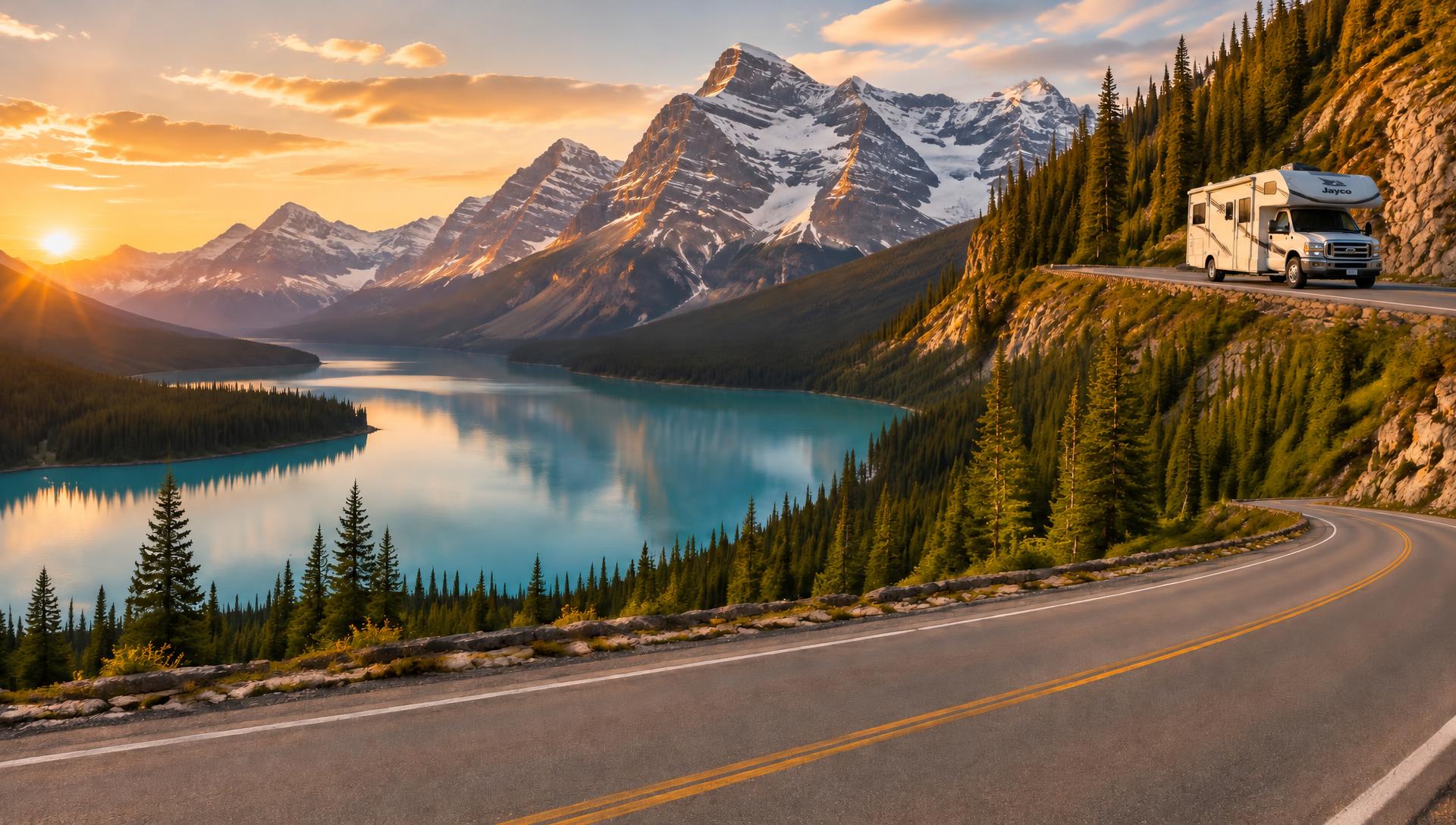
One-way trips are hugely popular — Vancouver ↔ Calgary through the Rockies is the classic. Expect a one-way fee (roughly C$300–1,500 depending on route and season).
Distance grid (km / driving hours)
| Vancouver | Calgary | Edmonton | Whitehorse | Toronto | Montreal | Halifax | |
|---|---|---|---|---|---|---|---|
| Vancouver | — | 970 km / 11h | 1,160 km / 12.5h | 2,400 km / 28h | 4,400 km / 45h | 4,800 km / 50h | 6,000 km / 62h |
| Calgary | 970 km / 11h | — | 300 km / 3h | 2,300 km / 25h | 3,400 km / 34h | 3,750 km / 38h | 5,000 km / 50h |
| Edmonton | 1,160 km / 12.5h | 300 km / 3h | — | 2,000 km / 22h | 3,450 km / 35h | 3,600 km / 37h | 4,850 km / 49h |
| Whitehorse | 2,400 km / 28h | 2,300 km / 25h | 2,000 km / 22h | — | 5,400 km / 57h | 5,600 km / 59h | 6,850 km / 72h |
| Toronto | 4,400 km / 45h | 3,400 km / 34h | 3,450 km / 35h | 5,400 km / 57h | — | 540 km / 5.5h | 1,800 km / 18h |
| Montreal | 4,800 km / 50h | 3,750 km / 38h | 3,600 km / 37h | 5,600 km / 59h | 540 km / 5.5h | — | 1,250 km / 13h |
| Halifax | 6,000 km / 62h | 5,000 km / 50h | 4,850 km / 49h | 6,850 km / 72h | 1,800 km / 18h | 1,250 km / 13h | — |
Hours are pure driving at highway speed. In an RV, add 20–30% and plan 250–400km a day.
Popular shorter hops
| From | To | km | Hours |
|---|---|---|---|
| Vancouver | Port Coquitlam | 30 | 0.5 |
| Vancouver | Abbotsford | 70 | 1 |
| Vancouver | Whistler | 125 | 2 |
| Vancouver | Kelowna | 390 | 4.5 |
| Calgary | Banff | 130 | 1.5 |
| Banff | Jasper | 290 | 4 |
| Edmonton | Jasper | 365 | 4 |
| Toronto | Hamilton | 70 | 1 |
| Toronto | Niagara Falls | 130 | 1.5 |
| Toronto | Algonquin (Hwy 60) | 270 | 3.5 |
| Montreal | Quebec City | 255 | 3 |
| Montreal | Ottawa | 200 | 2.25 |
| Halifax | Cabot Trail (Chéticamp) | 440 | 5 |
| Whitehorse | Dawson City | 535 | 7 |
| Whitehorse | Skagway (AK) | 175 | 2.5 |
| Whitehorse | Anchorage (AK) | 1150 | 15 |
Crossing into the USA
⚠ Check the return country
Most Canadian rental fleets require return to an approved Canadian depot. Permission to visit the USA does not mean permission to leave the vehicle there. Treat a Canada–USA one-way as unavailable unless the operator explicitly sells and confirms that exact arrangement in writing.
- Tell your rental company in advance — some charge a cross-border fee and confirm insurance cover.
- Bring passports and any visas/ESTA. Declare all food — fresh fruit, veg, meat and firewood are often confiscated.
- Popular US side trips: Glacier NP from Calgary, Seattle & the Olympic Peninsula from Vancouver, New England from Montreal.
Alaska from Canada
Yes, you can! From Whitehorse it's about 15 hours to Anchorage via the Alaska Highway. Skagway and Haines are short scenic hops. You must still bring the RV back to Canada. Check which roads are permitted — gravel routes like the Top of the World and Dempster are often restricted.
Ferries that take RVs
- Alaska Marine Highway — coastal Alaska services and southern connections depend on the published schedule. Do not assume a Prince Rupert departure is available. Confirm vehicle space, border requirements and rental permission.
- BC Ferries — Inside Passage Port Hardy ↔ Prince Rupert, and Vancouver ↔ Vancouver Island.
More in ferries, tolls & fees.
What does a one-way really cost?
The drop fee is only one line on the quote. A cheaper daily rate can lose its advantage once you add mileage packages, fuel, extra nights, insurance options and the flight home. Compare the full holiday cost in both directions. Vancouver to Calgary and Calgary to Vancouver may carry different prices because rental companies need vehicles in different places at different times.
One-way charges commonly run from a few hundred dollars into four figures, with scarce routes costing more or simply being unavailable. The fee may vary by vehicle category, travel date and depot pair. Check whether tax is included and whether changing the return location later triggers a new fee. Never assume two branches of the same brand can accept any vehicle.
- Price both directions using the same dates, vehicle class and mileage allowance.
- Include airport transfers: rental depots are often well outside city centres.
- Check minimum hire periods and pickup or return days.
- Leave room for fuel, propane, cleaning and any late-return charges.
A loop can be better value if the backtracking is modest. A one-way can be better value if it removes several long driving days. Paying a drop fee to gain two proper days in the Rockies may make more sense than buying fuel to race back across them.
Use the distance grid as a starting point
The table is a planning tool, not a promise about arrival time. Mountain grades, roadworks, ferry connections, border queues and wildlife stops all add time. An RV also needs fuel stops, grocery runs, dump stations and somewhere legal to spend the night. Keep pickup and return days light: paperwork and depot opening hours can swallow a surprising chunk of them.
For a relaxed mountain itinerary, a few shorter driving days usually beat a string of maximum-distance days. Build a spare night into longer routes and avoid booking a flight immediately after the scheduled vehicle return. A closed highway can turn a comfortable one-way into an expensive scramble.
Relocation deals: cheap wheels, strict clock
Relocations move a specific vehicle to a specific depot by a deadline. Headline rates can be extremely low, sometimes only a few dollars a day, but availability is unpredictable. You usually get a fixed route, a limited number of days and a mileage allowance. Extra days, if allowed, may cost the normal rental rate.
Read what is actually included. Fuel contributions, ferry allowances and equipment kits appear on some offers, not all. Security deposits, insurance excesses, taxes and cleaning requirements still matter. Ask what happens if a flight delay prevents collection or a road closure affects the delivery deadline.
These deals suit flexible travellers who enjoy the drive itself. They are a poor fit for a tightly booked national-park holiday or anyone hoping to detour for a week. Secure the relocation before buying non-refundable flights, and calculate the total rather than celebrating the daily rate.
US entry: permission and paperwork are different
Your rental company's approval covers the vehicle, not your immigration status. Every traveller needs documents appropriate to their nationality and situation. Canadian citizens generally do not need ESTA for an ordinary visit; eligible Visa Waiver Program travellers generally do need an approved ESTA for land entry. Others may need a visa. Check current US Customs and Border Protection guidance before departure.
An I-94 admission record and associated fee may apply depending on your circumstances. ESTA is not a visa and does not guarantee admission. Carry passports, the rental agreement, proof of cross-border permission and insurance details. Families travelling with children should check supporting-document recommendations, particularly when a parent or guardian is absent.
Declare food, plants and animal products, and let officers decide what can enter. Restrictions change with disease outbreaks and product origin. Do not carry cannabis across the international border, even between places where possession is legal. Check current pet-entry rules well ahead of time; requirements can depend on the animal's age and travel history.
Alaska needs a little extra slack
A road trip to Alaska from southern Canada is a major expedition, not a casual add-on. Starting in Whitehorse cuts the approach substantially, but remote fuel stops, construction and weather still influence daily mileage. Keep the tank comfortably topped up and download maps before losing service.
Get written approval for Alaska, Yukon and any proposed northern highways. Operators may restrict the Dempster Highway, Dalton Highway, Top of the World Highway, unpaved roads or travel on particular dates. A road being publicly open does not mean your rental insurance permits it. Check roadside-assistance coverage and how breakdown recovery works far from a depot.
Routes via Haines or Skagway can involve repeated border crossings, and ferries add fixed check-in deadlines. Keep passports accessible, allow weather buffers and confirm seasonal border hours. The best northern itinerary leaves time to stop, not just enough time to return the keys.
🍁 Top tip
Look for relocation deals — companies need RVs moved between depots, especially Vancouver/Calgary in spring and back in autumn. Rates can be C$1–25 a day.